Brand & creative
Marketing creatives
Campaign assets work better when the message, audience and action are clear. I develop a visual direction that can be applied across social, display, launch and sales material without each asset feeling unrelated.
Enquire about this service ↗
HOW I CAN HELP
Build creative that belongs to your brand.
Channel-specific creative assets
A consistent message across formats

THE APPROACH
From the brief to a clear direction.
Yes. I can develop a core creative direction and adapt it for social posts, advertisements, website banners and print materials, with deliverable sizes agreed upfront.
The campaign objective, channels, required formats and source assets.
THE APPLICATION
Built around the way you work.
Yes. Share the guidelines, existing assets, message and audience so the campaign feels consistent with your brand.
Discuss your briefCampaign creative is where strategy becomes something people actually see, and where many businesses lose consistency. This page explains how I plan creative for social, display, print and sales material, how I decide what to produce, and how to tell whether a creative is doing its job without relying on guesswork.
Creative starts with one clear job
Before design, I ask what a piece of creative is supposed to make someone do. Know the brand, click through, enrol for a demo, visit a shop, forward it to a colleague. Each of these asks for a different kind of image and copy. A launch announcement and a retargeting ad share a brand but not a brief. If the job is vague, the result is usually a pleasant graphic nobody acts on.
So I write a short creative brief for each campaign: the audience, the single message, the action, the channels and the formats. It is brief on purpose, usually one page. It gives you something to approve before any design time is spent, and it gives me a standard to defend or revise the work against when feedback arrives.
I also ask what the viewer already knows. A message for existing customers can be short and assume context. A message for strangers must introduce the brand, the benefit and the reason to care within the same frame. Mixing the two audiences in one piece usually serves neither well, so I separate them where the budget allows.
From one idea to a set of assets
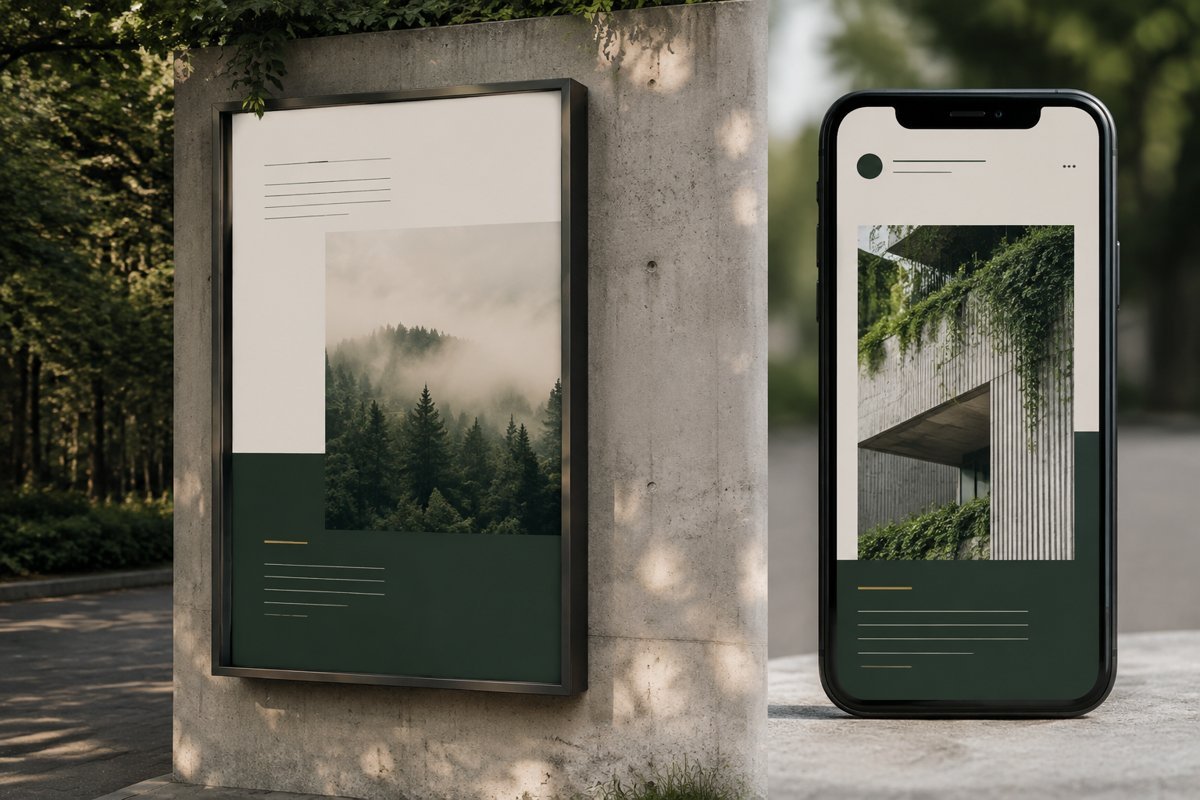
I develop a core creative idea first, a visual and verbal device that can stretch across formats. It might be a recurring layout, a distinctive way of using photography or illustration, or a consistent line of copy. Then I adapt it to the formats you need: social posts and stories, display and banner sizes, website hero sections, email headers, flyers, print ads, event material. The adaptation matters, because a design that works in a landscape banner often fails as a vertical story.
Sizes and specifications are agreed upfront. Each platform has its own dimensions, safe zones and text limitations, and these change from time to time, so I check current requirements when production begins instead of relying on memory. That prevents the common problem of important text hidden behind a platform's interface elements.
Handover matters as much as design. You receive layered source files and a tidy export folder, with names that say what each file is and where it goes. When your team or media buyer needs a new size six weeks later, they can produce it without rebuilding the whole piece or sending me a message.
- Creative brief: audience, message, action, channels and success signal.
- Core idea and visual direction, applied to a first hero asset.
- Adaptation across the agreed formats and sizes.
- Editable source files and exports named clearly for your team or media buyer.
- A short usage note so later additions stay consistent.
Working within, or extending, your brand
If you already have brand guidelines, I work inside them, and I will flag where they get in the way of a channel. Guidelines written for print often lack rules for motion, small mobile screens or user-generated style content. In those cases I propose sensible extensions and document them, rather than quietly drifting away from the identity.
If you do not have guidelines, I establish the basics from your existing material: a colour set, a type pairing, a layout approach and a tone for the copy. That is a light version of identity work. When the brand itself is unclear, the better route is to settle Brand strategy and positioning or Logo and visual identity first, then build campaign assets on top of that base.
Testing creative properly
The honest way to learn which creative works is to compare versions under similar conditions. In paid channels, that means running variants against the same audience with one meaningful difference between them, such as the headline, the image or the offer, and letting enough impressions and results accumulate before deciding. Changing several things at once, or judging after a day, tells you little.
I design with testing in mind. That means building a small set of deliberate variants, naming them so results can be traced back, and agreeing in advance what counts as a better result. I do not offer benchmark figures, because they vary by industry, audience and budget. Your own account data, measured consistently, is the only benchmark worth trusting.
Mistakes I see in campaign creative
Trying to say everything in one asset is the most common. A single post carrying five offers and four logos is weaker than five focused posts. The second is inconsistency across channels, where the Instagram look, the email look and the website look feel like different companies. The third is ignoring the first second: on social feeds, the opening frame or the headline area decides whether anyone stays.
Others include using weak or generic stock imagery, hiding the call to action, and designing only on a desktop monitor. Always preview on a phone, outdoors if possible. Also watch for text-heavy graphics where a caption would do the job better, and for creative that leans on a trend which will make your message look dated within weeks.
What I need from you
The campaign objective and timeline, the audience, the offer and any terms that must appear, such as dates and conditions. Send brand guidelines and existing assets, logos in vector format, product photos, and any past creative that performed well or badly with notes on why you think so. Tell me which channels and formats are required, and who is running the media, so the files suit them.
I also need a single point of approval and honest feedback on the first round. A comment such as "I don't like it" is hard to act on, while "it feels too formal for our audience" gives me direction. If legal or compliance review applies, such as for financial or health claims, build that into the schedule from the start.
How to tell whether it worked
Match the measurement to the job. For awareness, you look at reach and recall signals. For traffic, click-through and the quality of the visit afterwards. For leads, form completions and how good those leads are. For sales, tracked orders. The creative is one factor alongside targeting, budget, offer, landing page and timing, so poor results do not always mean poor creative.
That is why this service connects to others. If creative gets the click but the page loses the visitor, the problem sits in Website design and development. If the message lands in a pitch but not in a meeting, Presentations and pitch decks may be the place to improve. I look at the whole path before changing the assets.
One asset, one message, one action. Add more only when the first three are clear.
When this is not the right move
If there is no clear offer or audience, creative will not rescue the campaign. Producing more graphics in that situation just creates more material to ignore. Start with the offer and the message, and then design.
Also, if you only need a handful of simple social posts and have templates that work, you may not need a consultant for it. A template and a competent team member can cover that. I am most useful where the creative direction needs to be set, extended across channels, or made consistent after it has drifted.
WAYS TO WORK TOGETHER
A focused project. Or ongoing support.
Start with a strategy session. We can then agree a project brief, a focused consultation or an ongoing engagement around your priorities.
YOUR QUESTIONS, ANSWERED
Marketing creatives FAQs
Scope, preparation and what happens next.
Can one campaign work across several formats?
Yes. I can develop a core creative direction and adapt it for social posts, advertisements, website banners and print materials, with deliverable sizes agreed upfront.
Can you work within existing brand guidelines?
Yes. Share the guidelines, existing assets, message and audience so the campaign feels consistent with your brand.
What should I prepare for our first conversation?
The campaign objective, channels, required formats and source assets.
How are the scope and timeline agreed?
I review your requirements, starting material and target date before proposing milestones. For marketing creatives, the schedule depends on complexity, review rounds and the access or assets needed.
How much does this service cost?
Start with a strategy session at ₹2,999 + GST. A digital audit starts from ₹19,999 + GST, and ongoing monthly options start at ₹50,000 + GST for SEO consulting or ₹75,000 + GST for a consulting retainer. Project delivery is scoped and quoted separately; we can choose the right arrangement for your brief.