Search & growth
On-page SEO
On-page work connects the page’s purpose with the language and information visitors need. I look at titles, headings, content and internal links in the context of the wider site.
Enquire about this service ↗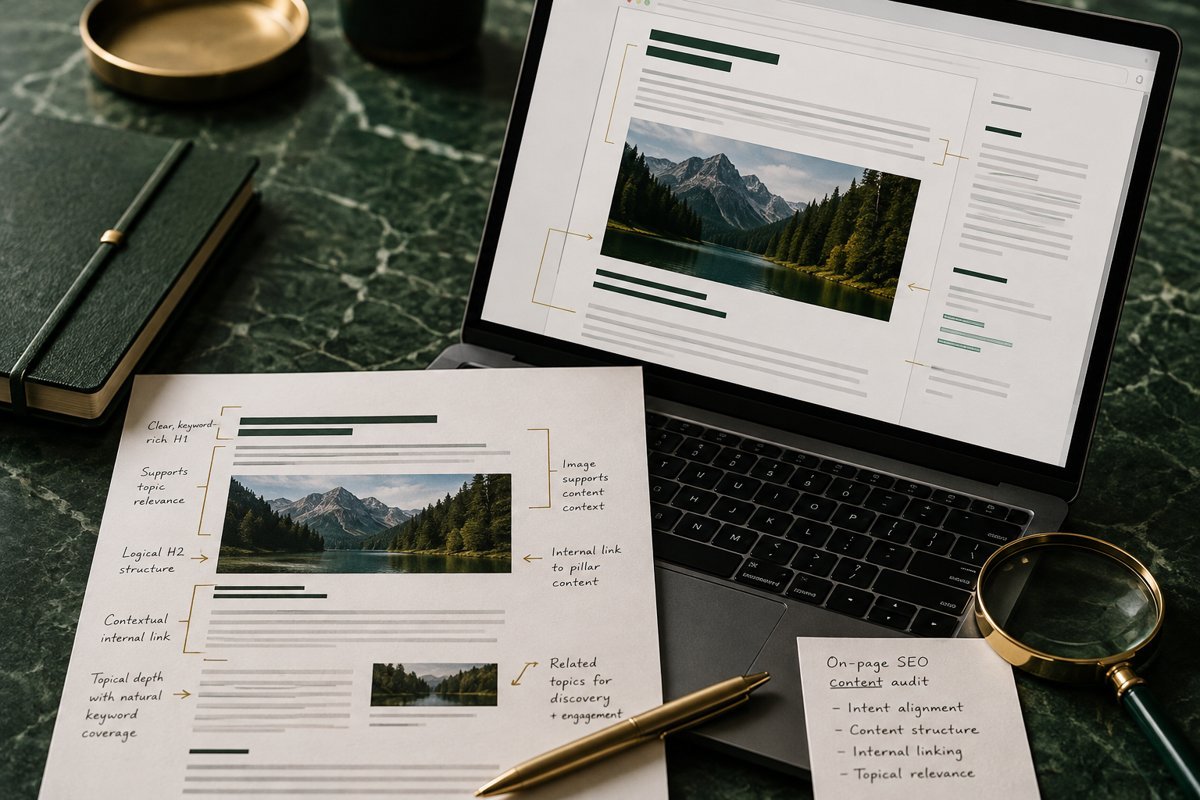
HOW I CAN HELP
Make each page clearer and more useful.
Heading and content structure
Internal-link recommendations

THE APPROACH
From the brief to a clear direction.
I can review search intent, titles, headings, content clarity, internal links and image context, with recommendations shaped around the purpose of each page.
Priority pages, audience questions and current content.

THE APPLICATION
Built around the way you work.
Yes. I can improve the structure and copy so visitors understand the service and the next step, while keeping the content accurate to your offer.
Discuss your briefOn-page work is the part of SEO you control completely, which makes it tempting to overdo. Done well, it means each page has one clear job, says what it is about in the words visitors use, and points to the next useful page. Done badly, it means keyword-stuffed headings and copy nobody enjoys reading.
Start with the page's job
Before touching a title tag, I ask what the page is for. A service page exists to help a buyer decide whether to enquire. A guide exists to answer a question. A category page exists to help someone choose. These have different shapes, and optimising them the same way is a common mistake.
Then I check what people searching for this topic expect to find. Looking at the results pages for the target query tells me whether searchers want a comparison, a how-to, a price, a definition or a provider. If the page offers the wrong thing, no amount of tidying will help.
This step also protects against copying competitors blindly. If every top result is a long guide and your page is a short sales pitch, that is useful to know. If the top results are product pages and you plan a blog post, that is worth knowing too. I let the evidence from the results shape the page type, then bring your own expertise to make it better than what exists.
I also ask who reads the page and what they already know. A buyer comparing providers wants proof and clarity on process. A person new to the topic wants a plain explanation first. Writing for the wrong level, too technical or too basic, loses the reader early, and no tag changes that. Knowing the audience shapes the vocabulary, the length and the order of information on the page.
Search intent and one page per purpose
Many sites have several pages competing for the same query, or one page trying to rank for four unrelated ones. Both dilute the signal and confuse visitors. I map target topics to pages, merge pages that overlap, and propose new pages where a real need has no home.
This mapping is the base for everything else. It tells writers what each page must cover, tells developers which URLs to keep, and tells me which internal links to recommend. It is a simple table, but building it forces decisions that are otherwise left to chance.
Cannibalisation, where your own pages compete, is easy to miss because each page looks fine alone. A short audit often finds three pages that all half-answer the same question, none strong enough to stand out. Consolidating them into one clearer page, with redirects from the old addresses, is often better than writing anything new.
What I review on a page
The checks are practical and each one is tied to either search engines understanding the page or people deciding to act. I do not tick off a generic checklist for its own sake.
For each priority page, I deliver specific replacement text and structural notes, not a generic comment such as 'improve headings'. That keeps the work usable by whoever edits your site.
Titles and descriptions get special attention because they are what people see before they click. A title should say plainly what the page offers, include the main topic naturally and be short enough to display. Descriptions will not always be used by search engines, but they still influence clicks when they are. I write both for humans, and I check that no two pages share them.
- Title and meta description: accurate, distinct, written for a person scanning results.
- Headings: a logical outline that matches how the reader thinks through the topic.
- Body content: whether it answers the real questions, in order, with evidence and clear next steps.
- Internal links: sensible paths from related pages, using descriptive link text.
- Images: relevant, with alt text that describes them and file sizes that do not slow the page.
- Structured data: marked up where it accurately reflects what is on the page.
Writing for readers first
Search engines are good at understanding language now. Repeating a phrase many times does not help and it makes the page worse. I focus on covering the topic fully, using the natural terms your customers use, and answering the questions that come just after the first one.
For service pages that means being specific about what you do, who it is for, how it works, what it costs or how pricing is decided, and what happens after someone makes contact. Vague, polished copy that could describe any provider fails both readers and search. I can rewrite pages or give your writers a clear brief, and the claims always stay accurate to your actual offer.
Layout matters too. A reader scanning on a phone should find the answer to their question without hunting. Short paragraphs, descriptive subheadings, clear calls to action and honest details such as how the process works, what it involves and what happens next all help. Pages that are well organised for people are usually well organised for search engines as well.
If a page would be just as true for your competitor, it is not specific enough to rank or to convert.
Internal links and site structure
Internal links tell search engines which pages matter and how topics relate, and they help visitors move toward a decision. I review which pages receive links, which important pages are buried, and whether link text says anything useful. 'Click here' says nothing.
I recommend a small number of deliberate links from relevant content to the pages that should perform. Adding links everywhere dilutes their value. For larger sites this review overlaps with technical SEO, where crawl paths and structure are examined at scale.
Where the platform allows, I also look at templates and not only individual pages. A fix applied to a template, such as how titles are generated for every product or article, can improve hundreds of pages at once. Equally, a flaw in a template spreads widely, so a template check often yields the best return on a limited budget.
How the work is delivered and sequenced
I begin with the pages closest to producing enquiries or revenue, not the whole site. A typical first batch is the main service pages, the home page and a few supporting articles. We learn from that batch before widening the work.
Each page goes through the same loop: a review, a recommendation, an edit and a check after publishing. How long this takes depends on the number of pages, how quickly your team can approve changes and how much rewriting is needed. I would rather improve ten pages properly than touch two hundred lightly.
Reviews after publishing are part of the job. I check that the changes appeared as intended, that nothing broke, and that search engines have picked up the new versions. Then, after enough time has passed for search data to settle, we look at how the pages perform and decide whether they need another pass or can be left alone.
When on-page work will not be enough
Page improvements cannot fix a site that search engines cannot crawl, a topic where established sites with far more authority dominate, or an offer that does not match what people want. In those cases I will point toward technical SEO, off-page SEO or a change in targeting before more page edits.
On-page changes also take time to be reflected in search, and the effect depends on your starting point. I do not promise positions. I promise that pages will be clearer, more accurate and easier for both people and search engines to understand.
There are also situations where the page is already good and the real constraint is demand. A well-written page on a topic few people search for will not bring volume, however polished. Knowing this saves you from endlessly reworking a page that is fine. The content strategy question then changes to which new pages could serve people who are asking.
When I finish a round of changes, I leave you with a simple page guide your team can reuse: how to write titles, structure headings, add internal links and brief new content. It keeps future pages consistent without needing me for each one, and it makes the improvements last beyond the initial engagement.
WAYS TO WORK TOGETHER
A focused project. Or ongoing support.
Start with a strategy session. We can then agree a project brief, a focused consultation or an ongoing engagement around your priorities.
YOUR QUESTIONS, ANSWERED
On-page SEO FAQs
Scope, preparation and what happens next.
What do you review on a page?
I can review search intent, titles, headings, content clarity, internal links and image context, with recommendations shaped around the purpose of each page.
Can you rewrite existing service pages?
Yes. I can improve the structure and copy so visitors understand the service and the next step, while keeping the content accurate to your offer.
What should I prepare for our first conversation?
Priority pages, audience questions and current content.
How are the scope and timeline agreed?
I review your requirements, starting material and target date before proposing milestones. For on-page seo, the schedule depends on complexity, review rounds and the access or assets needed.
How much does this service cost?
Start with a strategy session at ₹2,999 + GST. A digital audit starts from ₹19,999 + GST, and ongoing monthly options start at ₹50,000 + GST for SEO consulting or ₹75,000 + GST for a consulting retainer. Project delivery is scoped and quoted separately; we can choose the right arrangement for your brief.